
Key Takeaways
AI search tools like ChatGPT, Gemini, and Perplexity work very differently from Google, which means businesses that rank well on Google can still be invisible when customers ask AI for recommendations.
In one test, only 6 out of 50 businesses showed up in AI search results, even though several of the invisible companies had strong Google rankings and were spending thousands on ads.
AI systems face a "selection problem" instead of a ranking problem, meaning they pick a small handful of trusted sources rather than displaying a long list of options.
Fixing vague website copy, cleaning up technical indexing issues, and building consistent citations across the web are the fastest ways to get a business showing up in AI searches.
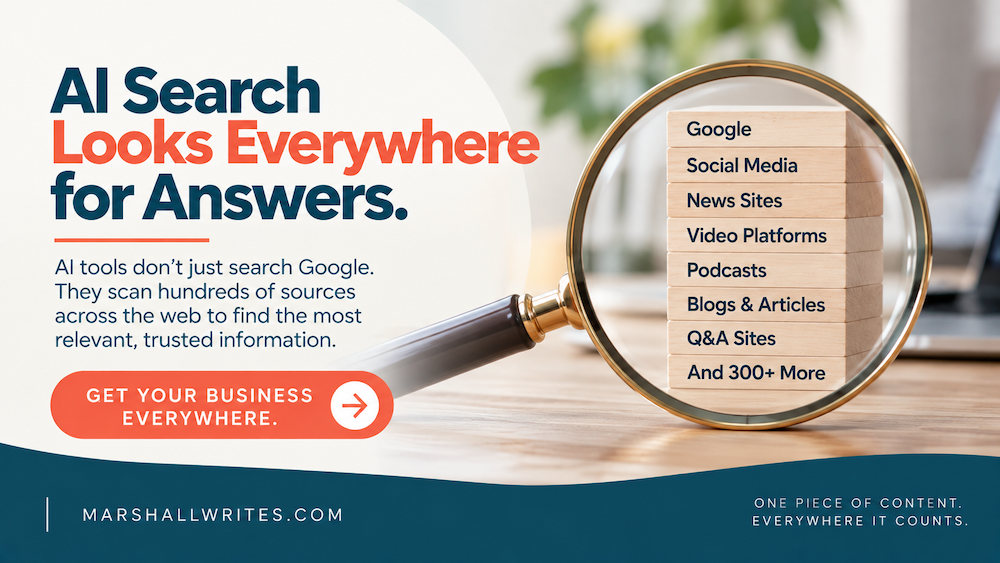
Agencies like Marshall Writes have helped businesses grow visibility across AI platforms using a multicasting approach that spreads one piece of content across hundreds of destinations.
A business might be doing everything right on Google and still be a ghost when someone asks ChatGPT for a recommendation.
That gap is becoming a real problem for business owners. Traditional search used to be the only game in town, but now a huge chunk of buyer research happens elsewhere. According to Marshall Writes, only about 27% of buyer research still happens through traditional Google search, while the remaining 73% spreads across YouTube, social media, podcasts, and AI tools. If a business isn't showing up there, it's missing most of the conversation before it even starts. Article: Let's break down why AI tools skip over certain businesses, even successful ones, and walk through the specific fixes that move a business from invisible to recommended. Here are real numbers from businesses that tested their visibility across ChatGPT, Gemini, and Perplexity, along with the technical and content changes that made the difference.
Only 6 Out of 50 Businesses Show Up in AI Search Results
A recent test of 50 businesses across ChatGPT, Gemini, and Perplexity found that only 6 appeared in AI-generated answers. The other 44 were completely invisible, and this wasn't just small, struggling companies getting overlooked. Several of the invisible businesses had strong Google rankings and were actively spending thousands of dollars per month on Google ads, proving that ad budget and Google performance don't translate into AI visibility.
This disconnect matters because customer behavior has shifted dramatically. Buyers no longer rely on a single search engine to make decisions, and the businesses that don't show up across multiple channels are losing ground to competitors who do.
73% of Buyer Research Now Happens Outside Google
Google used to be the default starting point for nearly every purchase decision, but that's no longer true. With nearly three-quarters of buyer research happening outside traditional search, a business that only optimizes for Google is essentially fighting for a shrinking slice of attention. YouTube videos, podcast episodes, social posts, and AI-generated answers now carry weight that once belonged exclusively to search engine results pages.
Customers Check 5-6 Sources Before They Buy or Book
Buyers rarely decide after reading just one page. Most people check several sources before picking up the phone or filling out a contact form, comparing reviews, directory listings, social proof, and AI-generated summaries along the way. If a business is missing from even one or two of those touchpoints, it creates doubt at exactly the moment a customer is trying to build trust.
60% of Searches End With Zero Clicks
A growing share of searches never result in a click. Instead, the searcher gets their answer directly from an AI-generated summary or featured snippet and moves on. This means a business can have a fantastic website, but if that website never gets pulled into the answer itself, the traffic never arrives in the first place. A business may be absent because it doesn't clearly explain its services, doesn't optimize key pages, or faces other visibility issues.
AI Search and Google SEO Are Two Different Games
Ranking on Google and appearing in AI search results are not the same achievement, even though many business owners assume good SEO handles both. Google SEO and AI visibility function as "almost completely separate games," according to findings shared in industry discussions, and a business can rank on page one of Google for years while remaining a total unknown to AI tools.
The clearest example of this gap shows up with brand name searches. A business might rank perfectly when someone searches its exact name, yet disappear entirely during a discovery search, meaning a search where the customer doesn't already know the company exists. That distinction is critical because most customers using AI tools aren't searching for a specific business by name. They're asking broader questions like "best plumber near me" or "top-rated marketing agency for small businesses," and if a company hasn't earned a spot in the AI's trusted answer pool, it simply won't appear.
Google Ranks Pages, AI Search Picks Trusted Sources
Google's entire model revolves around ranking pages, giving searchers ten or more options to choose from on the first page alone. AI search tools work differently. Rather than presenting a list, tools like ChatGPT and Perplexity generate a direct answer, pulling it from a handful of sources they've decided to trust.
This shift changes the entire strategy. Businesses used to compete for position on a list, hoping to land in the top three or five spots. Now they're competing to be one of the few sources an AI system trusts enough to reference, which is a fundamentally different challenge than traditional keyword ranking.
Why AI Tools Create One Answer Instead of a List
AI tools are built to give a fast, confident, singular answer rather than overwhelming users with options. This design choice means there's no page two in AI search. A business is either the answer the AI provides, or it doesn't factor into the conversation at all.
Entity Recognition: The System Must Know Who the Company Is
Before an AI tool can recommend a business, it needs something called entity recognition. In plain terms, the AI system needs to clearly understand what the business is, what it does, and what it's known for, and it needs to see that information consistently across multiple sources. A business that describes itself one way on its website, another way on its Google Business Profile, and yet another way in directory listings creates confusion that makes it harder for AI systems to confidently categorize and trust what that business actually offers.
Why 44 Out of 50 Businesses Were Invisible to AI
When researchers dug into why so many businesses disappeared from AI search results, the pattern wasn't random. The businesses that showed up shared specific traits, and the ones that didn't were missing the same handful of ingredients every single time. Understanding those gaps is the first step toward closing them.
Strong Google Rankings Don't Guarantee AI Visibility
It's tempting to assume that a business ranking on page one of Google has already won the visibility battle. That assumption falls apart the moment you run a test for the same business in ChatGPT or Perplexity. Several companies with excellent Google rankings and active ad spend still came up empty in AI-generated answers, proving that traditional SEO ranking doesn't automatically translate into AI trust.
Vague Website Copy Confuses AI Systems
Plenty of business websites lean on phrases like "innovative solutions," "results-driven strategies," or "helping companies grow." These phrases sound polished, but they don't tell an AI system what the company actually does, who it serves, or where it operates. When an AI tool can't pull a clear, specific answer from the company's content, it moves on to a competitor whose website spells things out plainly.
Missing or Unindexed Pages Kill a Business's Chances
A page that isn't indexed might as well not exist, no matter how well it's written. Accidental noindex tags, broken internal links, and pages buried too many clicks deep in a website's structure all prevent AI tools from finding and referencing that content. If Google can't access a page properly, it can't feed it into an AI-generated answer either.
Inconsistent Information Across Platforms Hurts Trust
AI systems cross-reference information across multiple sources before deciding whether to trust a business. When a company's name, phone number, service area, or business description doesn't match between its website, Google Business Profile, and directory listings, that inconsistency creates doubt. AI tools favor businesses that show the same accurate details everywhere a customer might encounter them.
What The 6 Winning Businesses Did Differently
The six businesses that did appear in AI search results weren't lucky. They had specific, repeatable elements in place that made it easy for AI tools to recognize, categorize, and confidently recommend them.
Structured Data and Schema Markup Setup
Every winning business had properly implemented schema markup, giving search engines and AI tools a clean, structured way to understand their services, location, and offerings. Schema markup alone won't force an AI tool to recommend a business, but it removes ambiguity and makes the categorization process easier.
Consistent Mentions in Industry Directories and News
None of the visible businesses existed in isolation. They showed up consistently across industry-specific directories, news mentions, and third-party references, giving AI systems multiple independent confirmations of who they are and what they do. This kind of consistent digital footprint builds the trust AI tools need before recommending a source.
Fully Optimized Google Business Profile
Every one of the six businesses maintained a fully built-out Google Business Profile that was updated regularly, not left stagnant for months or years. Accurate hours, services, photos, and review responses contributed to a profile AI tools could reference with confidence.
Clear Entity Recognition Across Multiple Sources
The common thread tying everything together was entity recognition. Each winning business was described the same way across its website, directories, and profiles, giving AI systems a consistent, trustworthy picture instead of a jumbled or contradictory one. That clarity is what separates a business AI tools confidently recommend from one they quietly skip.
Fix the Website Content First
Before chasing directory listings or worrying about schema code, website content needs to say something. This is often the fastest fix available, and it costs nothing but time.
Replace Generic Phrases With Specific Descriptions
Swap out broad statements for specifics. Instead of saying a company offers "innovative solutions for businesses," spell out exactly what it provides, who it's for, and where the service is available. A landscaping company in Denver should say "residential lawn care and snow removal in Denver, Colorado," not "premium outdoor solutions."
This level of specificity does double duty. It helps human readers understand the offer faster, and it gives AI tools the exact language they need to match a business to a customer's question.
Add Real Project Details, Pricing, and Case Studies
Generic advice about fast websites or mobile-friendly design already exists on thousands of competing pages, which makes it nearly worthless for standing out. What helps is content built from real project experience: screenshots, pricing ranges, before-and-after comparisons, and case studies drawn from actual work. That kind of original, specific evidence is exactly what AI tools look for when deciding which source to trust.
Quality Beats Quantity: Fewer Pages, More Proof
Publishing dozens of poorly written blog posts isn't an advantage. A smaller collection of clear, original, well-supported pages consistently outperforms a bloated content library filled with filler.
Pick the business's five most important service pages and rewrite them with specific, evidence-backed detail.
Remove or consolidate thin pages that repeat the same generic information.
Add real numbers, timelines, and outcomes wherever possible instead of vague promises.
Focusing effort on fewer, stronger pages gives AI tools a clearer signal about what a business actually delivers.
Solve Technical Issues Blocking AI Indexing
Even the best-written page is invisible if it's technically blocked from crawling or indexing. These issues are often invisible to business owners until someone specifically looks for them.
Check for Noindex Tags and Canonical Errors
Accidental noindex settings sometimes remain after a website redesign or migration, quietly telling search engines to skip a page entirely. Incorrect canonical tags can cause similar problems by pointing search engines to the wrong version of a page. Both issues are easy to overlook and easy to fix once you identify them.
Fix Broken Links and Buried Pages
Redirect errors, broken internal links, and pages buried too many clicks deep into a website's navigation all limit how easily search engines and AI tools can find important content. A page that takes five clicks to reach from the homepage is far less likely to get crawled regularly than one linked directly from the main menu. A business may be absent because it doesn't clearly explain its services.
Confirm Indexing Through Google Search Console
Google has rolled out a Search generative AI control in Search Console, and inclusion is the default for most properties. Business owners with access to their Search Console account should double-check that their property hasn't accidentally been excluded from this setting.
Running a basic site audit through Search Console at least once a quarter catches these problems before they quietly cost a business its visibility.
Build a Directory and Citation Strategy That Works
Citations across the web serve as third-party confirmation of what a business does, and AI tools rely heavily on that kind of outside validation before recommending a source. A business with zero third-party mentions can look invisible to AI systems, even if Google ranks it well.
Customer reviews, an accurately maintained Google Business Profile, professional association listings, and mentions on client websites all help confirm a company's identity and services. The goal isn't to chase every possible mention, but to build a consistent, accurate presence across the sources that matter most.
Industry-Specific Directories Beat General Ones Like Yelp
Not all directories carry equal weight. Industry-specific directories tend to matter more for AI visibility than general-purpose sites like Yelp, since they signal a more precise match between a business and its actual field of work.
A roofing company listed on a roofing industry directory sends a clearer signal than the same company appearing only on a generic local business listing site.
Why Local Service Businesses Have the Biggest Opportunity
Directory citations for local service businesses act like an 80/20 solution, delivering most of the visibility benefit for relatively little effort. These citations typically take 60 to 90 days to start showing up in ChatGPT results, so patience matters here as much as consistency.
Understand How Different AI Tools Behave
Testing visibility on just one AI platform gives a skewed, incomplete picture. ChatGPT, Gemini, and Perplexity don't all operate the same way, and a business invisible on one might already be showing up on another.
Perplexity Picks Up New Citations Fast
Perplexity relies on live retrieval, meaning it pulls fresh information from the web in real time. New citations and mentions can show up in Perplexity's answers faster than in other tools.
ChatGPT Takes Longer to Trust New Sources
ChatGPT leans more heavily on information baked into its training data, which means it takes longer to "lock on" to new sources. A business that just built out its citations and directory presence shouldn't expect overnight results inside ChatGPT specifically.
Checking visibility across all three major platforms, rather than relying on a single test, gives a far more accurate picture of where a business actually stands.
Test Discovery Searches, Not Just Brand Searches
Typing a business name into ChatGPT and getting an accurate response feels reassuring, but it doesn't prove much. The real test is whether an AI tool recommends this business to someone who has never heard of it before.
Why Searching a Specific Business Name Doesn't Prove Anything
A brand name search only confirms that the AI tool has some baseline information about that business. It says nothing about whether that business would ever get surfaced during an actual customer's search for a service provider in their area.
How AI Decides If a Business Matches a Customer's Request
Discovery searches, meaning searches phrased the way a real customer would ask them, reveal whether an AI tool considers a business a strong match for that need. Try phrases like "best HVAC company near [city]" or "top-rated marketing agency for small businesses" instead of the company's actual name. If a business doesn't appear in several variations of these discovery-style questions, that's the clearest sign; visibility work is still needed.
Real Results From Businesses That Got This Right
None of this matters much without proof, and the businesses that fixed their AI visibility gaps have the numbers to show for it. These aren't small bumps in traffic either. They're the kind of results that come from getting found consistently across every channel a customer might use to research a purchase.
"A fitness equipment brand went from zero visitors to more than 25,000 monthly visitors, generating over $100,000 in monthly organic sales and pulling 304 buyers away directly from competitors." — Marshall Writes Research
That kind of shift doesn't happen by accident. It happens when a business shows up consistently across search engines, social platforms, YouTube, podcast directories, and AI tools like ChatGPT and Perplexity at the same time, rather than betting everything on one channel.
A Medical Device Company Grew Sales From $48K to $735K
One medical device company saw a 20,000% traffic increase within 12 months, growing monthly sales from $48,000 to $735,000. That growth came from a multicasting approach, where a single piece of content gets reshaped into multiple formats and distributed across hundreds of destinations at once.
News articles picked up by industry publications
Blog posts optimized for both search engines and AI retrieval
Social posts, infographics, and short videos built from the same core content
Podcast episodes and longer videos reaching audiences on different platforms
Spreading the same message across eight different formats and 300+ destinations gives AI tools far more opportunities to encounter and trust a business, rather than relying on a single webpage to carry all the weight.
An Epoxy Flooring Business Made $1.6M With Zero Ad Spend
An epoxy flooring company brought in $1.6 million in sales over 12 months without spending a dollar on ads. A windows and doors company saw over $6,000 in return on investment from a single well-placed article. Both results point to the same lesson: visibility built through consistent, well-distributed content outperforms paid ads that stop working the moment the budget runs out.
What to Fix First This Week
Fixing AI visibility doesn't require rebuilding an entire website overnight. Most businesses see meaningful movement by tackling three specific areas first, in order of impact.
Start small, measure what changes, and expand from there. Trying to fix everything simultaneously usually means nothing gets fixed properly.
Start With the Most Important Service Page
Pick the single service or product page that drives the most revenue and rewrite it with specific, evidence-backed detail. Replace vague marketing language with exact descriptions of what's offered, who it serves, and where it's available.
This one page becomes the template for how the rest of the site should read. Once it's live, monitor whether it starts appearing in discovery-style AI searches over the following weeks.
Strengthen Evidence With Reviews and Case Studies
Reviews and case studies act as third-party proof that AI tools weigh heavily when deciding whether to trust a business. Add real customer reviews, request new ones consistently, and build out at least one detailed case study showing an actual project from start to finish.
Correct Every Inconsistent Business Listing
Search every major directory, the Google Business Profile, and any client or partner websites for outdated business names, phone numbers, or service descriptions. This matters even more after a rebrand, domain migration, office move, or major service change, since old information tends to linger in places business owners forget to check.
The Window to Become the Default AI Recommendation Is Closing
Once an AI system picks a business as a trusted source for a particular topic or service, it tends to reuse that same name repeatedly across future queries. This creates a compounding advantage for businesses that establish visibility early, and a compounding disadvantage for those that wait.
Most local businesses won't figure this out for another two to three years. By then, the same three or four names in each market will likely already be locked in as the default AI recommendation, making it much harder for new entrants to break through.
The businesses moving on this now aren't necessarily the biggest names in their industry. They're the ones willing to fix vague copy, clean up technical errors, and build consistent citations before competitors even realize this shift is happening.
Frequently Asked Questions
These are the questions business owners ask most often once they realize their business isn't showing up in AI searches.
How Long Does It Take to Show Up in ChatGPT Search Results?
Directory citations for local service businesses typically take 60 to 90 days to show up in ChatGPT results. Perplexity tends to pick up new citations faster because it relies on live retrieval, while ChatGPT leans more on training data and takes longer to pick up new sources.
Consistency matters more than speed here. A business that keeps building accurate citations over several months will eventually earn recognition, even if the first few weeks show no visible change.
Does Schema Markup Guarantee AI Will Recommend a Business?
Schema markup helps search engines and AI tools understand a business's services, location, and offerings more clearly.
It does not force any platform, including Google or ChatGPT, to recommend a business.
It works best when paired with clear website content, consistent citations, and a fully built-out Google Business Profile.
Think of schema markup as removing friction, not guaranteeing a result. It makes it easier for AI tools to categorize a business correctly, but the underlying content and citations still need to hold up on their own.
Businesses expecting schema markup alone to fix their AI visibility usually end up disappointed, since it addresses only one piece of a much larger puzzle.
Can Businesses Rank Well on Google But Still Be Invisible to AI?
Yes. Google SEO and AI visibility function almost as separate games, and a business can rank on page one of Google for years while remaining completely unknown to ChatGPT, Gemini, or Perplexity. Several businesses with strong Google rankings and active ad spend still failed to appear in AI-generated search results during testing.
What's the Fastest Way to Improve AI Visibility for a Local Business?
Directory citations represent an 80/20 solution for local service businesses, delivering a large share of the visibility benefit for relatively little effort. Pairing accurate directory listings with a fully optimized Google Business Profile gives local businesses the quickest, most realistic path to AI recognition.
From there, tightening up website content and fixing technical indexing issues rounds out the strategy for longer-term, sustained visibility.
Do Businesses Need a Separate Technical Setup for AI Overviews?
Google's Search generative AI control inside Search Console defaults to inclusion, meaning most properties don't need any special setup. Business owners with Search Console access should simply confirm their property hasn't accidentally been excluded from this setting.
Beyond that single check, the same technical fundamentals apply: fix noindex errors, correct canonical tags, repair broken links, and make sure important pages aren't buried too deep in the site's navigation.
Getting these basics right gives a business's best content a fair shot at appearing in AI-generated answers, rather than being technically blocked from the start. Marshall Writes Client Cabin
Hi, this is a comment.
To get started with moderating, editing, and deleting comments, please visit the Comments screen in the dashboard.
Commenter avatars come from Gravatar.